In a town deep in the Florida Everglades, where high school football is
the only escape, a haunted quarterback, a returning hero, and a scholar
struggle against terrible odds.
The loamy black "muck" that
surrounds Belle Glade, Florida once built an empire for Big Sugar and
provided much of the nation's vegetables, often on the backs of roving,
destitute migrants. Many of these were children who honed their skills
along the field rows and started one of the most legendary football
programs in America. Belle Glade's high school team, the Glades Central
Raiders, has sent an extraordinary number of players to the National
Football League - 27 since 1985, with five of those drafted in the first
round.
The industry that gave rise to the town and its team also
spawned the chronic poverty, teeming migrant ghettos, and violence that
cripples futures before they can ever begin. "Muck City" tells the story
of quarterback Mario Rowley, whose dream is to win a championship for
his deceased parents and quiet the ghosts that haunt him; head coach
Jessie Hester, the town's first NFL star, who returns home to "win kids,
not championships"; and Jonteria Willliams, who must build her dream of
becoming a doctor in one of the poorest high schools in the nation. For
boys like Mario, being a Raider is a one-shot window for escape and a
college education. Without football, Jonteria and the rest must make it
on brains and fortitude alone. For the coach, good intentions must
battle a town's obsession to win above all else.
Beyond the Friday
night lights, this book is an engrossing portrait of a community mired
in a shameful past and uncertain future, but with the fierce will to
survive, win, and escape to a better life.
Check Catalog
Sports
You can click the links to check availability.
Monday, March 25, 2013
Monday, March 18, 2013
Winning Spirit Basketball: Find Your Greatness Within
Winning Spirit Basketball grew out of conversations between basketball
great Chris Mullin and sports psychologist Tom Mitchell about players,
coaches, parents and the game of basketball. The book was written
specifically for players who want to gain a competitive edge and a
better understanding of the habits and behaviors that are key to an
athlete's success: confidence, communication, work ethic, teamwork,
practice and concentration. It is also valuable for parents and coaches
who want to help players develop their mental game.Though written by a
Hall of Fame player and former basketball head coach, this book is not
about the Xs and Os of basketball. Readers will not learn how to run a
play, shoot a free throw, or break a full court press. Rather, they will
learn about the values within the game of basketball that help you
become a better player on the court and a better person in life. Through
basic, easy-to-understand messages and exercises, athletes of all ages
will be able to put the things they learn from this book into practice
immediately.
Check Catalog
Check Catalog
Monday, March 11, 2013
Build the Swing of a Lifetime: The Four-Step Approach to a More Efficient Swing
The best way to shave multiple strokes off your golf game is to
develop an efficient, repeatable swing that enables you to hit the ball
farther and straighter with greater consistency. To achieve this ideal
swing, you need a clear picture of the finished product and a simple
step-by-step process for building it, testing it, and maintaining it.
Now you have it.
In Build the Swing of a Lifetime, Mike Bender, one of Golf Digest's 5 Best Teachers in America, shows you how to develop the same swing that boosted the careers of 2007 Masters champion Zach Johnson, multiple PGA Tour winner Jonathan Byrd, and 2006 LPGA Rookie of the Year Seon Hwa Lee.
Mike Bender didn't become the 2009 PGA National Teacher of the Year by offering quick fixes and compensations for deficient swings. He did it by creating a science-based, biomechanical approach to understanding the elements of an efficient, powerful, repeatable swing and devising a simple, checkable method for practicing and perfecting that swing.
In four simple steps illustrated by 150 photographs, Mike shows you how to aim and turn properly, get your hands on the correct downswing plane, and match up your arm swing and body rotation to square the clubface more consistently. He provides clear and simple guidance on how to make sure you're practicing each step correctly. Using broken club shafts, construction cones, and other forms of feedback, you'll discover how to check your alignment and posture, and make sure that your shaft and hands are moving on-plane in good sequence with one another.
There are a million ways to hit a golf ball, but only one is the most efficient way to produce shots that are consistently long and on target, and only one will help you keep shaving that handicap down toward scratch for as long as you keep playing. That is the swing you will develop by practicing and applying what you learn in Build the Swing of a Lifetime.
Check Catalog
Monday, March 4, 2013
The Wild Duck Chase: Inside the Strange and Wonderful World of the Federal Duck Stamp Contest
"The Wild Duck Chase "takes readers into the peculiar world of
competitive duck painting as it played out during the 2010 Federal Duck
Stamp Contest-the only juried art competition run by the U.S.
government. Since 1934, the duck stamp, which is bought annually by
hunters to certify their hunting license, has generated more than $750
million, and 98 cents of each collected dollar has been used to help
purchase or lease 5.3 million acres of waterfowl habitat in the U.S.-the
core of the National Wildlife Refuge System.
As Martin J. Smith chronicles in his revealing narrative, within the microcosm of the duck stamp contest are intense ideological and cultural clashes between the mostly rural hunters who buy the stamps and the mostly suburban and urban birders and conservationists who decry the hunting of waterfowl. At issue is preserving the habitat of ducks and other waterfowl for all to enjoy: If the number of hunters continues to decrease-and unless nature lovers support the duck stamp program-this landmark conservation effort faces possible extinction.
The competition also fuels dynamic tensions between competitors and judges, and among the invariably ambitious, sometimes obsessive, and often eccentric artists-including Minnesota's three fabled Hautman brothers, the "New York Yankees" of competitive duck painting. Martin Smith takes readers down an arcane and uniquely American rabbit hole into a wonderland of talent, ego, art, controversy, scandal, big money, and migratory waterfowl.
Check Catalog
Monday, February 25, 2013
The Perfect Game: How Villanova's Shocking 1985 Upset of Mighty Georgetown Changed the Landscape of College Hoops Forever
A veteran Philadelphia Inquirer sportswriter and Pulitzer Prize finalist, Frank Fitzpatrick has long followed and covered Villanova basketball. In all that time, nothing compares with the Wildcats' legendary 1985 upset of Georgetown--a win so spectacular and unusually flawless that days after its conclusion, sports columnists were already calling it "The Perfect Game."
The game, particularly its second half, was so different from what observers expected--so different, in fact, from what anyone had ever seen that a shroud of myth almost immediately began to envelop it. Over the years, the game took on mythological proportions with heroes and villains, but with a darker, more complex subtext. In the midst of the sunny Reagan Administration, the game had been played out amid darker themes--race, death, and, though no one knew it at the time, drugs.
It was a night when the basketball world turned upside down. Villanova-Georgetown would be a perfect little microcosm of the 1980s. And it would be much more. Even now, a quarter-century later, the upset gives hope to sporting Davids everywhere. At the start of every NCAA Tournament, it is recalled as an exemplar of March's madness. Whenever sport's all-time upsets are ranked, it is high on those lists, along with hockey's Miracle on Ice. Now, through interviews with the players and coaches, through the work of sociologists and cultural critics, through the eyes of those who witnessed the game, Fitzpatrick brings to life the events of and surrounding that fateful night.
Check Catalog
Wednesday, February 20, 2013
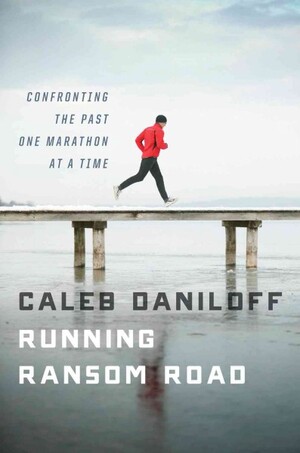
Running Ransom Road: Confronting the Past, One Marathon at a Time
The monikers "drunk," "addict," "abuser," and "boozehound "were Caleb
Daniloff's for fifteen years. Now, the introduction that fits him best
is "My name is Caleb and I am a runner."
In Running Ransom Road, Daniloff, many years sober, confronts his past by setting out, over the course of eighteen months, to run marathons in the cities where he once lived and wreaked havoc. Competing from Boston to New York, Vermont to Moscow, Daniloff explores the sobering and inspiring effects of running as he traverses the trails of his former self, lined with dark bars, ratty apartments, lost loves, and lost chances. With each race he comes to understand who he is, and by extension who he was, and he finds he is not alone. There are countless souls in sneakers running away from something, or better, running past and through whatever it is that haunts them.
In this powerful story of ruin, running, and redemption, Daniloff illuminates the connection between running and addiction and shows that the road to recovery is an arduous but conquerable one. Strapping on a pair of Nikes won't banish all your demons, but it can play an important role in maintaining a clean life. For Daniloff, sweat, strained lungs, and searing muscles are among the paving stones of empowerment, and, if he's lucky, perhaps even self-forgiveness.
Check Catalog
Monday, February 11, 2013
Soldiers First: Duty, Honor, Country, and Football at West Point
The football team at the U.S. Military Academy is not like other college football teams. At other schools, athletes are catered to and coddled at every turn. At West Point, they carry the same arduous load as their fellow cadets, shouldering an Ivy League-caliber education and year-round military training. After graduation they are not going to the NFL but to danger zones halfway around the world. These young men are not just football players, they are soldiers first.
"New York Times" sportswriter Joe Drape takes us inside the world of Army football, as the Black Knights and their third-year coach, Rich Ellerson, seek to turn around a program that had recently fallen on hard times, with the goal to beat Navy and "sing last" at the Army-Navy game in December. The 2011 season would prove a true test of the players' mettle and perseverance.
Drawing on his extensive and unfettered access to the players and the coaching staff, Drape introduces us to this special group of young men and their achievements on and off the field. Anchoring the narrative and the team are five key players: quarterback Trent Steelman, the most gifted athlete; linebacker Steve Erzinger, who once questioned his place at West Point but has become a true leader; Andrew Rodriguez, the son of a general and the top scholar-athlete; Max Jenkins, the backup quarterback and the second-in-command of the Corps of Cadets; and Larry Dixon, a talented first-year running back. Together with Coach Ellerson, his staff, and West Point's officers and instructors, they and their teammates embrace the demands made on them and learn crucial lessons that will resonate throughout their lives--and ours.
Check Catalog
Monday, February 4, 2013
Straight Shooter: The Brad Park Story
Monday, January 28, 2013
The Ultimate Super Bowl Book: A Complete Reference to the Stats, Stars, and Stories Behind Football's Biggest Game--And Why the Best Team Won (2ND ed.)
With a television viewership of over 100 million people and hundreds of
millions of dollars spent each year on tickets, concessions, and
merchandise alone, the Super Bowl is the greatest game on Earth.
Offering in-depth analysis, detailed statistics, play-by-play recaps,
and post-game insights for every Super Bowl ever played, "The Ultimate
Super Bowl Book" is the most definitive reference to this iconic
sporting event, exploring all the high and lows from more than four
decades of gridiron drama, with stories and quotes from the men who made
history on football's biggest stage. In addition to a comprehensive
examination of each Super Bowl played since 1967, the book presents
features on the greatest individual performances in Super Bowl
history--from Joe Namath to Joe Montana, Tom Brady to Aaron Rodgers,
Marcus Allen to Emmitt Smith, Jack Lambert to James Harrison--and the
best and worst decisions by some legendary coaches, including Vince
Lombardi, Chuck Noll, Bill Parcells, Bill Belichick, Mike McCarthy, and
more. Author Bob McGinn weighs in on the biggest Super Bowl shockers,
the worst blunders, and the most entertaining characters. Quotes from
players and coaches take you to the sidelines and into the huddle with
the greatest teams in Super Bowl History, including the Green Bay
Packers, Pittsburgh Steelers, Dallas Cowboys, New England Patriots, and
more. No sporting event can compete with the Super Bowl--and no book can
compete with this one as the ultimate reference to the ultimate game.
Check Catalog
Check Catalog
Tuesday, January 22, 2013
Nature Wars: The Incredible Story of How Wildlife Comebacks Turned Backyards Into Battlegrounds
This may be hard to believe but it is very likely that more people live
in closer proximity to more wild animals, birds and trees in the eastern
United States today than anywhere on the planet at any time in history.
For nature lovers, this should be wonderful news -- unless, perhaps,
you are one of more than 4,000 drivers who will hit a deer today, your
child's soccer field is carpeted with goose droppings, coyotes are
killing your pets, the neighbor's cat has turned your bird feeder into a
fast-food outlet, wild turkeys have eaten your newly-planted seed corn,
beavers have flooded your driveway, or bears are looting your garbage
cans.
For 400 years, explorers, traders, and settlers plundered North American wildlife and forests in an escalating rampage that culminated in the late 19th century's "era of extermination." By 1900, populations of many wild animals and birds had been reduced to isolated remnants or threatened with extinction, and worry mounted that we were running out of trees. Then, in the 20th century, an incredible turnaround took place. Conservationists struggled to reverse wildlife devastation by outlawing commercial hunting, creating wildlife sanctuaries, transplanting isolated species to restored habitats and imposing regulations on hunters and trappers. Over decades, they slowly nursed many wild populations back to health.
But after the Second World War something happened that conservationists hadn't foreseen: sprawl. People moved first into suburbs on urban edges, and then kept moving out across a landscape once occupied by family farms. By 2000, a majority of Americans lived in neither cities nor country but in that vast in-between. Much of sprawl has plenty of trees and its human residents offer up more and better amenities than many wild creatures can find in the wild: plenty of food, water, hiding places, and protection from predators with guns. The result is a mix of people and wildlife that should be an animal-lover's dream-come-true but often turns into a sprawl-dweller's nightmare.
"Nature Wars" offers an eye-opening look at how our well-meaning efforts to protect animals allowed wild populations to burgeon out of control, causing damage costing billions, degrading ecosystems, and touching off disputes that divided neighborhoods, polarized communities, and wreaked havoc on local politics. What's more, award-winning journalist and reporter Jim Sterba demonstrates what happens when Americans now spend 90% of their time indoors and how our society lost touch with the natural landscape and got its ideas about nature from films and television shows where wild creatures act like humans or are portrayed as furry, cuddly animals.
A deeply researched, eloquently written, counterintuitive and often humorous look at relations between man and beast--and the deepening chasm between the two--" Nature Wars" will be the definitive book on how we created this unintended mess.
Check Catalog
Subscribe to:
Posts (Atom)